Blog
/
How People Are Discovering Branded Podcasts in 2026

How People Are Discovering Branded Podcasts in 2026

Branded podcast discovery has moved beyond podcast apps. See where audiences actually find shows in 2026 and how to best reach them.
July 16, 2026
Contents

If your brand launched a podcast in the last few years, someone probably built a distribution checklist. 

✅ Submit to Apple

✅ Submit to Spotify

✅ Line up some cross-promo swaps

✅ Cut a launch trailer

✅ Wait for the charts to do the rest

But new research says that this checklist won’t cut it (shocking, I know).

40% of listeners now say they discovered their favorite podcast on YouTube, more than double any other single source. Podcast discovery has moved out of podcast apps and into the places people already spend their time: YouTube, social feeds, search, and the group chat.

For an enterprise marketing team, that's going to influence where your promotion budget goes, what your episodes need to look like, and how you prove the podcast works to the people who signed off on it.

In this article, we’re leaning on the latest research from Sounds Profitable on podcast discovery to show you how people are actually finding podcasts in 2026, and what it means for the show your brand is about to launch or the one that isn't pulling the numbers you expected.

TL;DR

  • YouTube isn’t optional: 40% of listeners discovered their favorite podcast there, and 40% call it their most-used podcast platform, ahead of Spotify (18%) and Apple Podcasts (11%).
  • Podcasting isn't one channel anymore: YouTube and social together account for 61% of people's favorite podcast discovery engines. Listening apps are no longer where most people first find you.
  • Organic beats paid for discovery: Among people who found a podcast through social, 60% found it through content shared by someone they follow, versus 33% through sponsored posts.
  • Word of mouth is still the quiet powerhouse: 64% of listeners get podcast recommendations from friends, family, or colleagues, and 72% say they're likely to act on them.
  • Each channel is a different audience: TikTok skews young, Spotify listeners are highly engaged (61% listen weekly), and Apple browsers skew affluent and audio-first. 
  • Discovery doesn’t stop at launch week: The brands that win treat it like the long game it is. 

Podcasting isn't one channel anymore

For most of its life, "podcasting" meant one behavior: You opened an app, you subscribed, you listened while doing something else. Promotion followed the same logic. Get in the app, climb the app's charts, and hope the app recommends you.

That model is breaking, and the data is revealing why. People now find and consume podcasts as audio, as video, as 45-second clips, as newsletter links, and as recommendations passed between friends in the group chat. Same medium, completely different entry points and consumption patterns.

For a brand, the takeaway is simple. Listening apps can no longer be the center of how you promote, because it's no longer where most people find you. A launch built on chart position, in-app cross-promotion, and a subscribe button is optimized for how podcasts used to get found, not how they get found today. The rest of this article breaks down where people actually discover podcasts now, and what your show needs to do to get found in each place.

YouTube is the new front door to podcast discovery

40% of listeners said they discovered their favorite podcast on YouTube, and the same percentage also named YouTube as the platform they use most to listen, well ahead of Spotify at 18% and Apple Podcasts at 11%. This isn't just a Sounds Profitable finding, either. Edison Research's Infinite Dial 2025 also put YouTube as the most-used service for podcast listening.
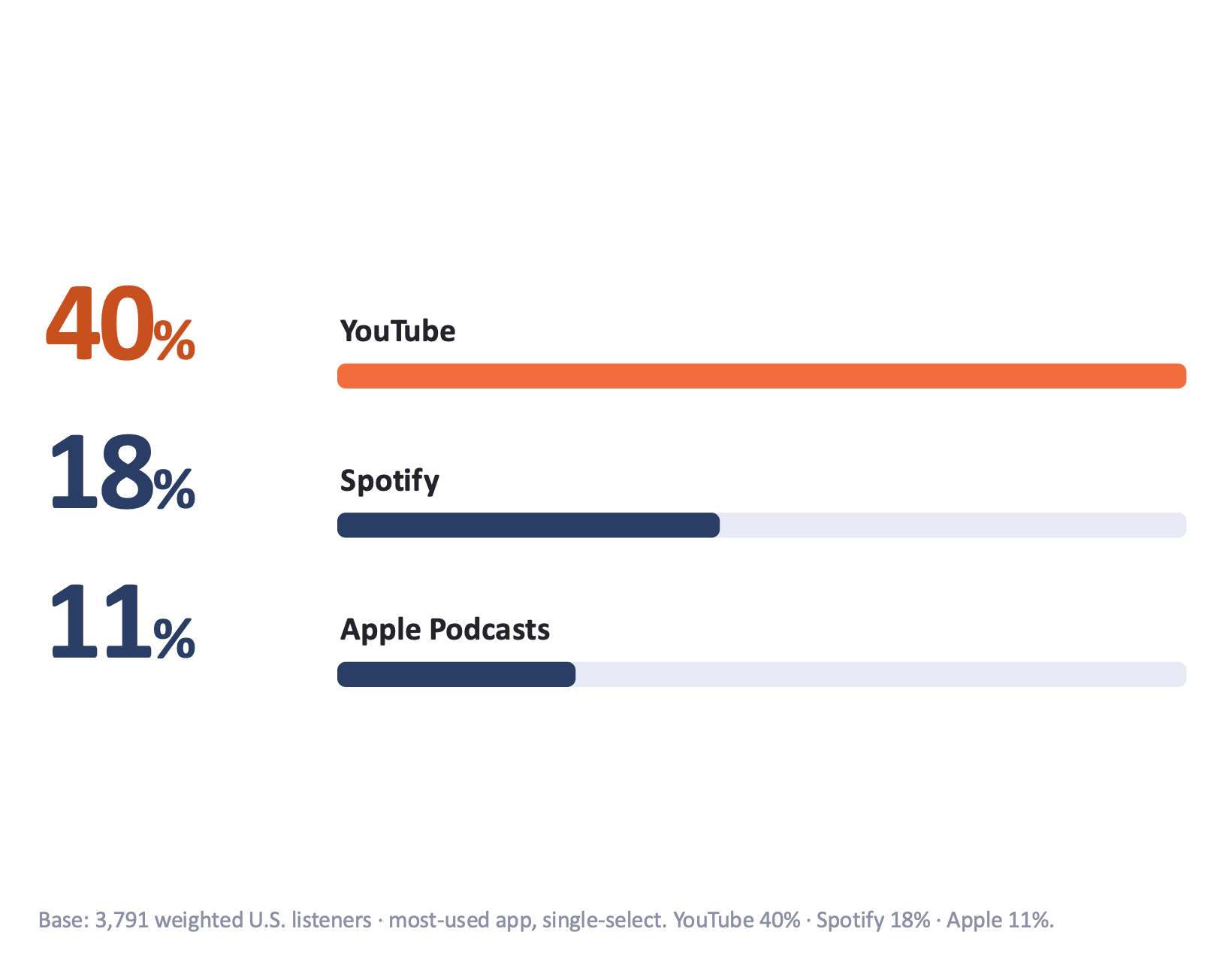
Chart showing 60% of social podcast discovery comes from content shared by someone the listener follows, versus 33% from sponsored content.

Here’s what marketers need to know: YouTube being the biggest podcast platform doesn't just add a line to your distribution list. It changes how you make the show. YouTube is a video platform and a search engine at the same time, and it surfaces content that's built to be watched, searched, and clipped. A 40-minute episode uploaded as a static audio waveform is technically "on YouTube," but it gives YouTube almost nothing to recommend.

But the good news is that you don't need a film crew, a set, or even full video episodes to get found here. Most YouTube discovery runs on two things: 

  1. Short clips
  2. Searchable text

And both are within reach of an audio-first show. Here are the highest-leverage ways to optimize for YouTube discovery, even if you never publish a full video episode:

  • Post short clips as Shorts: Cut the two or three sharpest moments from each episode into 30 to 60-second vertical clips with captions burned in. No studio video required; an animated waveform, the guest's headshot, and big on-screen text are enough. Shorts are one of YouTube's largest discovery surfaces, and they funnel viewers to the full episode.
  • Write titles like search queries, not episode labels: "How a CFO cut onboarding time by 40%" gets found. "Episode 42: A conversation with Jane Doe" does not. YouTube is a search engine, so title it for what your audience actually types into it.
  • Front-load the description with the words people search: A real summary, the guest's name and company, and the topics covered in the first two or three lines beat a bare link dump. That text is what YouTube reads to decide who to show your episode to.
  • Add chapters: Breaking an episode into labeled timestamps lets YouTube surface a single relevant moment, so someone searching "pricing strategy" can land right on that segment instead of scrubbing through an hour.
  • Upload accurate captions: YouTube reads your captions for search, and a clean transcript makes clips faster to cut. 
  • Design a real thumbnail: A high-contrast image with a face and a few words will out-click plain cover art every time, even on an audio episode. 
  • Group episodes into playlists: Themed playlists (by topic, by guest type, by season) keep people watching and signal to YouTube what your channel is about.

The organic vs. paid split (and why it matters for your budget)

The instinct when you learn discovery is happening on social is to open an ad account. But let’s slow your roll for just a second.

Among listeners who discovered a favorite podcast through social media, 60% found it through content shared by someone they follow. Only 33% found it through sponsored content. Organic reach, from real people posting real clips, is doing most of the work.
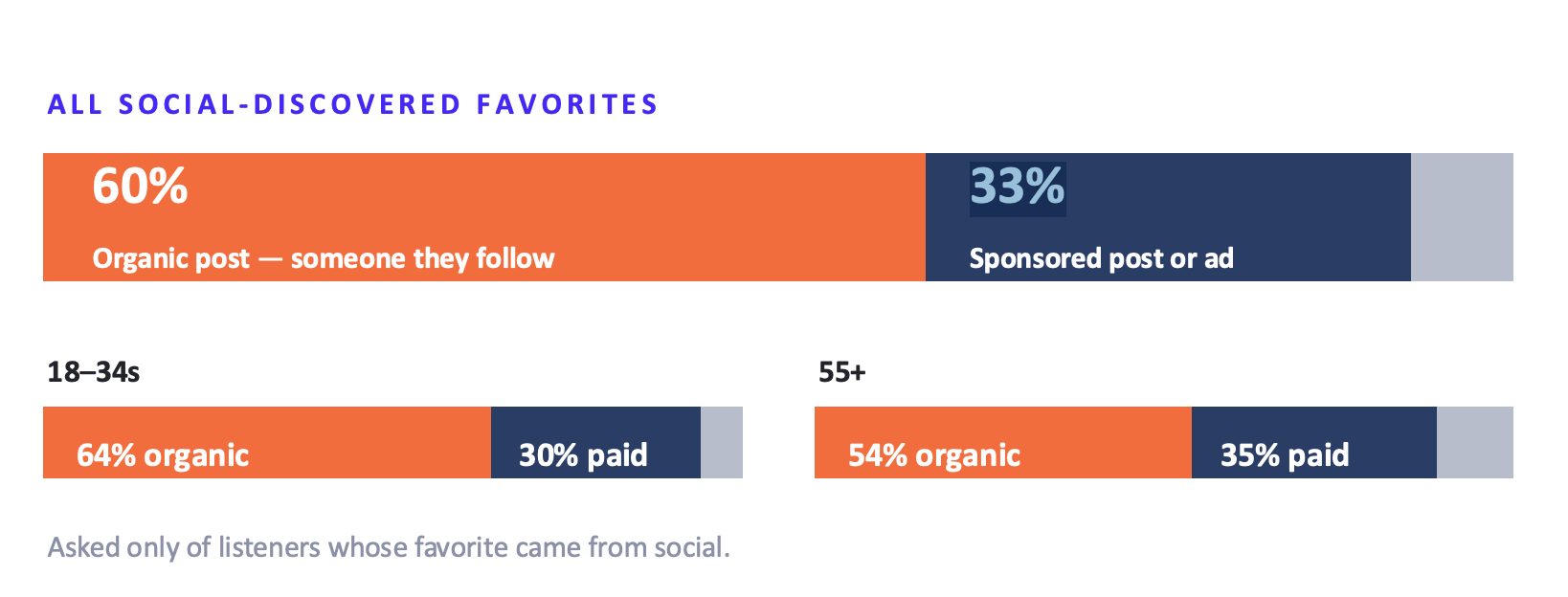
Chart showing 60% of social podcast discovery comes from content shared by someone the listener follows, versus 33% from sponsored content.

But that doesn't mean paid is pointless. It just means that paid and organic do different jobs. Organic reach, especially clips your host and guests share with their own audiences, drives most of the real discovery, because a post from someone you follow reads as a personal recommendation rather than an ad. Paid is how you get in front of people who don't already know your brand, but those people have no relationship with the show yet, so it takes more spend to earn the same attention.

For a branded show, the practical read is that before you spend, make sure the people in and around your podcast (your host, your guests, your executives, your employees) are actually posting the thing. That organic layer is nearly free, and it outperforms sponsored content for discovery. 

But that only happens if you make sharing effortless. Don't count on guests and employees to cut their own clips. Give each of them a ready-to-post kit with a couple of captioned clips sized for their platform, a couple of caption options, the episode link, and the show artwork.

Word of mouth is still king

For all the platform talk, the oldest discovery channel is still one of the strongest.

Nearly two-thirds of listeners (64%) get podcast recommendations from friends, family, or colleagues, and 72% say they're likely to act on them. A recommendation from a person you trust still beats almost any algorithm.

You can't buy word of mouth, but you can build the conditions for it. It happens when a show is worth mentioning and effortless to pass along. A few ways to actually earn it:

  • Make sharing take zero effort: Pull-quotes, captioned clips, and a clean episode link let someone forward it without writing a paragraph explaining what your show’s about. 
  • Book guests who bring their own audience: A guest with an engaged following is a word-of-mouth channel from day one. They share to people who already trust them, and that trust carries over to your show.
  • Arm your own team: Your sales and marketing people talk to your exact buyers every day. An episode that answers a common objection becomes a one-to-one asset they can send directly to a prospect. 

B2B has a built-in advantage here: a pointed episode on a niche industry problem is exactly the kind of thing one director forwards to another. 

Every channel is a different audience, not just a different pipe

This is the finding that should change how you plan a campaign, not just a launch.

The channels people use to discover podcasts aren't interchangeable. They come with different audiences, different behaviors, and different expectations. The people TikTok sends you are not the people Spotify sends you, and they don't want the same thing.
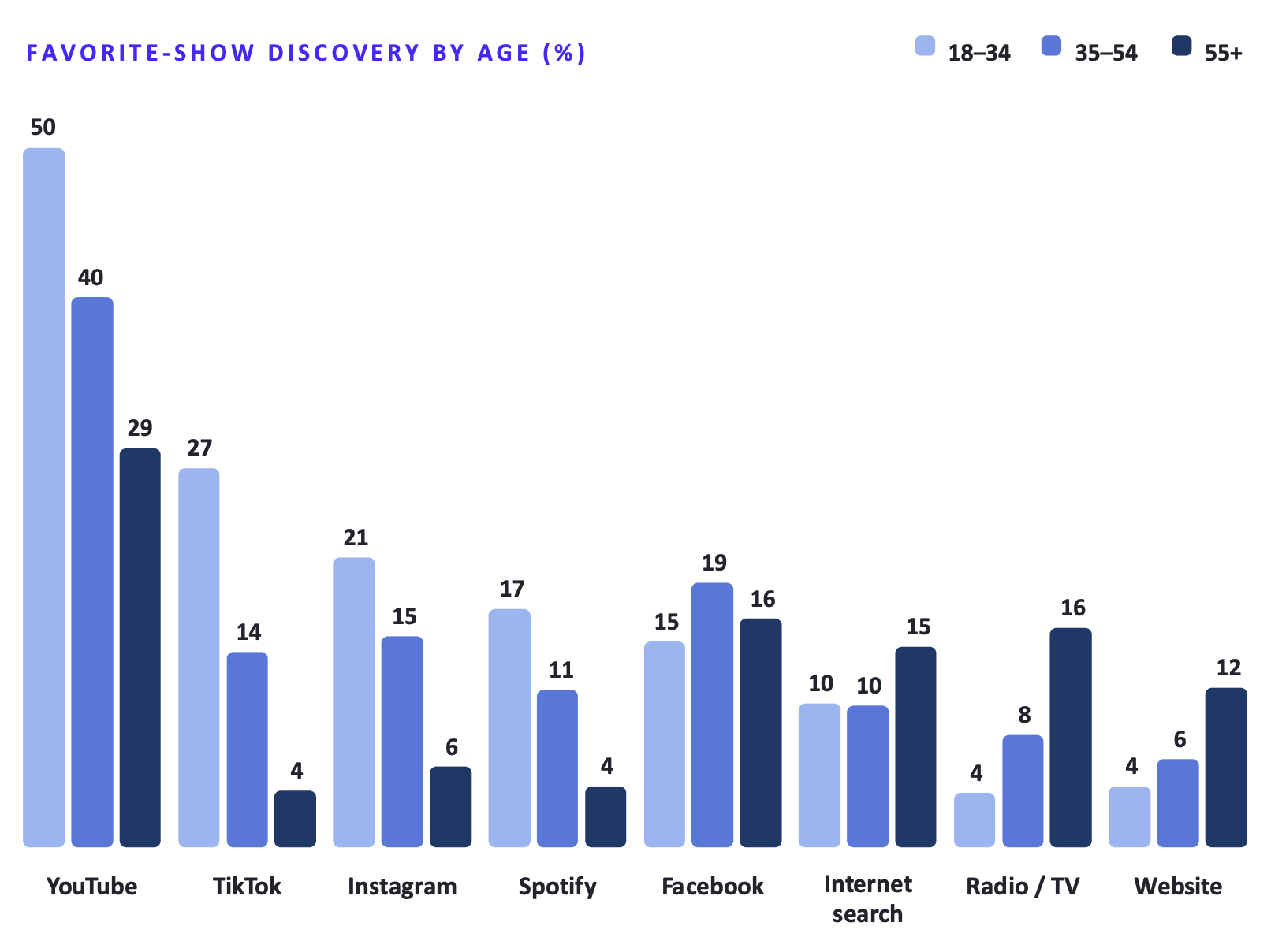
Chart showing podcast discovery channels by audience age, with TikTok and Spotify skewing younger and TV and radio skewing older.

Here are a few of the sharper differences:

  • TikTok is young: Discovery there is nearly 7x more common among listeners aged 18 to 34 than among those 55 and older.
  • Spotify is engaged: Listeners who discovered a show on Spotify are among podcasting's most committed, with 61% listening weekly, and they're notably brand-responsive.
  • Apple Podcasts is affluent and audio-first: Browsing inside Apple remains a real discovery mechanism, particularly in news and technology, among a higher-income, headphones-in audience.
  • Host recommendations deliver superfans: They're a smaller slice of overall discovery, but they bring in the most loyal listeners you'll get.

So one clip, reformatted five ways and blasted everywhere, is not a strategy. If your buyers over-index on LinkedIn and Apple, a TikTok-native edit is effort spent reaching people who will never buy from you. Match the creative and the channel to the audience you actually want.

Quill tip: Want to see exactly what companies, industries, and job roles are turning into your podcast? Find out using CoHost’s B2B Analytics. Plus, verify how your ICP is finding your show using Tracking Links

What this means for your branded podcast

Now that you’re well-versed with the findings, here's what to actually do with them:

  • Produce for video, or at least don't rule it out: If YouTube is the biggest front door, "audio-only, uploaded as a waveform" leaves your largest discovery channel half-built. Film the recording, even simply, so you have video and clips to work with later.
  • Treat clips as a core deliverable, not an afterthought. The organic content people share is mostly short clips. Budget for them up front, and build a bank of shareable moments from every episode.
  • Split organic and paid on purpose. Get your host, guests, and internal team posting first (that's your 60%). Use paid to extend past your existing orbit, and expect it to convert colder.
  • Right creative, right channel, right audience. Decide which platforms map to your buyers, then cut for those specifically. Don't reflexively be everywhere.
  • Engineer word of mouth. Give people a reason and an easy way to pass an episode along: A clear hook per episode, quotable clips, no caption required.
  • Feed search and AI answers. Show notes, transcripts, and companion blog posts are what Google, YouTube search, and AI tools can actually read. (More on that in our guide to boosting your branded podcast's SEO.)
  • Measure discovery by channel. If you can't see which channel sent you the listeners (and the accounts) that matter, you can't defend the budget. This is where analytics that show listener firmographics, not just raw downloads, earn their keep.
  • Run it for 12 months, not 12 weeks. Discovery compounds. The brands seeing results treat it as an ongoing system, not a launch-week sprint.

To make this concrete: Think about how you personally found the last new show you liked. Odds are it wasn't by browsing a podcast app's charts. It probably came after: 

  • A clip autoplayed on YouTube
  • A creator you follow posted a cut on Instagram
  • A colleague dropped a link in Slack with "this is exactly what we were talking about

That's discovery in 2026. The branded shows getting found are the ones built to be watched, clipped, and forwarded, not just heard.

Podcast discovery doesn’t stop at launch week

A lot of branded podcast strategy is still built on 2019 assumptions, aimed at podcast apps, measured by charts, and promoted with a trailer and a prayer. The medium has moved. Discovery now lives on YouTube, in social feeds, in search, and in personal recommendations.

Discovery isn't a moment you nail once; it's a habit you keep. Clips get shared for months. Search results and back-catalog episodes surface long after they publish. Word of mouth grows as more people listen. All of that rewards the show that's still posting in month nine, not the one that spent everything on premiere week and then went quiet.

So the brands seeing real results are treating discovery as an ongoing system: A steady clip cadence, titles and text that keep pulling in search traffic, and a channel mix they actually maintain.

Want to keep up with what's actually working in branded podcasting? Join the community of marketers who subscribe to The Branded Podcaster.

FAQ: Branded podcast discovery 

Where do most people discover podcasts in 2026?

Most new podcast discovery now happens outside podcast apps. YouTube is the single biggest source: 40% of listeners say they discovered their favorite podcast there, more than double any other channel. When you add social platforms like Facebook, TikTok, and Instagram, YouTube, and social together account for 61% of listeners’ favorite podcast discovery apps (Sounds Profitable, The Podcast Discovery Playbook 2026).

Is YouTube really bigger than Spotify and Apple for podcasts?

Yes, at least as a place people listen and discover. In the research, 40% of listeners named YouTube as their most-used podcast platform, compared with 18% for Spotify and 11% for Apple Podcasts (Sounds Profitable, 2026). Edison Research's Infinite Dial 2025 reached a similar conclusion, ranking YouTube as the most-used service for podcast listening. The practical implication is that a video and clip strategy now matters as much as your audio feed.

Should brands pay to promote their podcast on social media?

Paid promotion has a role, but organic does most of the discovery work. Among listeners who found a podcast through social media, 60% found it through content shared by someone they follow, versus 33% through sponsored content (Sounds Profitable, 2026). The takeaway for brands: Get your host, guests, and team sharing clips organically first, then use paid to extend reach beyond your existing audience.

Do people still discover podcasts through word of mouth?

Very much so. 64% of listeners receive podcast recommendations from friends, family, or colleagues, and 72% say they're likely to act on them (Sounds Profitable, 2026). Personal recommendations remain one of the most powerful discovery channels, which is why making a show easy to share (clear hooks, quotable clips) is worth building into production.

How should discovery change the way we launch a branded podcast?

Treat discovery as a 12-month system rather than a launch-week campaign, and build for the channels where people actually find shows. That means producing with video and clips in mind, matching creative to each platform's audience (TikTok skews young, Spotify listeners are highly engaged, Apple browsers skew affluent), seeding organic sharing before spending on paid, and measuring which channels bring in the right listeners, not just the most downloads.

Share

About the author

Tianna Marinucci is a content creation and digital marketing specialist. She graduated from McGill University in 2021 and has since worked in a variety of industries from interior design to technology.

After traveling to more than 60 countries and working in three, she is inspired by diverse cultures and motivated by unique experiences.

In her spare time, Tianna loves trying new foods, going to concerts, and learning more about history and socio-economics through books and podcasts.
More Like This

Branded Podcasts

How People Are Discovering Branded Podcasts in 2026

Last updated on: 
July 16, 2026

Branded podcast discovery has moved beyond podcast apps. See where audiences actually find shows in 2026 and how to best reach them.

If your brand launched a podcast in the last few years, someone probably built a distribution checklist. 

✅ Submit to Apple

✅ Submit to Spotify

✅ Line up some cross-promo swaps

✅ Cut a launch trailer

✅ Wait for the charts to do the rest

But new research says that this checklist won’t cut it (shocking, I know).

40% of listeners now say they discovered their favorite podcast on YouTube, more than double any other single source. Podcast discovery has moved out of podcast apps and into the places people already spend their time: YouTube, social feeds, search, and the group chat.

For an enterprise marketing team, that's going to influence where your promotion budget goes, what your episodes need to look like, and how you prove the podcast works to the people who signed off on it.

In this article, we’re leaning on the latest research from Sounds Profitable on podcast discovery to show you how people are actually finding podcasts in 2026, and what it means for the show your brand is about to launch or the one that isn't pulling the numbers you expected.

TL;DR

  • YouTube isn’t optional: 40% of listeners discovered their favorite podcast there, and 40% call it their most-used podcast platform, ahead of Spotify (18%) and Apple Podcasts (11%).
  • Podcasting isn't one channel anymore: YouTube and social together account for 61% of people's favorite podcast discovery engines. Listening apps are no longer where most people first find you.
  • Organic beats paid for discovery: Among people who found a podcast through social, 60% found it through content shared by someone they follow, versus 33% through sponsored posts.
  • Word of mouth is still the quiet powerhouse: 64% of listeners get podcast recommendations from friends, family, or colleagues, and 72% say they're likely to act on them.
  • Each channel is a different audience: TikTok skews young, Spotify listeners are highly engaged (61% listen weekly), and Apple browsers skew affluent and audio-first. 
  • Discovery doesn’t stop at launch week: The brands that win treat it like the long game it is. 

Podcasting isn't one channel anymore

For most of its life, "podcasting" meant one behavior: You opened an app, you subscribed, you listened while doing something else. Promotion followed the same logic. Get in the app, climb the app's charts, and hope the app recommends you.

That model is breaking, and the data is revealing why. People now find and consume podcasts as audio, as video, as 45-second clips, as newsletter links, and as recommendations passed between friends in the group chat. Same medium, completely different entry points and consumption patterns.

For a brand, the takeaway is simple. Listening apps can no longer be the center of how you promote, because it's no longer where most people find you. A launch built on chart position, in-app cross-promotion, and a subscribe button is optimized for how podcasts used to get found, not how they get found today. The rest of this article breaks down where people actually discover podcasts now, and what your show needs to do to get found in each place.

YouTube is the new front door to podcast discovery

40% of listeners said they discovered their favorite podcast on YouTube, and the same percentage also named YouTube as the platform they use most to listen, well ahead of Spotify at 18% and Apple Podcasts at 11%. This isn't just a Sounds Profitable finding, either. Edison Research's Infinite Dial 2025 also put YouTube as the most-used service for podcast listening.

Chart showing 60% of social podcast discovery comes from content shared by someone the listener follows, versus 33% from sponsored content.

Here’s what marketers need to know: YouTube being the biggest podcast platform doesn't just add a line to your distribution list. It changes how you make the show. YouTube is a video platform and a search engine at the same time, and it surfaces content that's built to be watched, searched, and clipped. A 40-minute episode uploaded as a static audio waveform is technically "on YouTube," but it gives YouTube almost nothing to recommend.

But the good news is that you don't need a film crew, a set, or even full video episodes to get found here. Most YouTube discovery runs on two things: 

  1. Short clips
  2. Searchable text

And both are within reach of an audio-first show. Here are the highest-leverage ways to optimize for YouTube discovery, even if you never publish a full video episode:

  • Post short clips as Shorts: Cut the two or three sharpest moments from each episode into 30 to 60-second vertical clips with captions burned in. No studio video required; an animated waveform, the guest's headshot, and big on-screen text are enough. Shorts are one of YouTube's largest discovery surfaces, and they funnel viewers to the full episode.
  • Write titles like search queries, not episode labels: "How a CFO cut onboarding time by 40%" gets found. "Episode 42: A conversation with Jane Doe" does not. YouTube is a search engine, so title it for what your audience actually types into it.
  • Front-load the description with the words people search: A real summary, the guest's name and company, and the topics covered in the first two or three lines beat a bare link dump. That text is what YouTube reads to decide who to show your episode to.
  • Add chapters: Breaking an episode into labeled timestamps lets YouTube surface a single relevant moment, so someone searching "pricing strategy" can land right on that segment instead of scrubbing through an hour.
  • Upload accurate captions: YouTube reads your captions for search, and a clean transcript makes clips faster to cut. 
  • Design a real thumbnail: A high-contrast image with a face and a few words will out-click plain cover art every time, even on an audio episode. 
  • Group episodes into playlists: Themed playlists (by topic, by guest type, by season) keep people watching and signal to YouTube what your channel is about.

The organic vs. paid split (and why it matters for your budget)

The instinct when you learn discovery is happening on social is to open an ad account. But let’s slow your roll for just a second.

Among listeners who discovered a favorite podcast through social media, 60% found it through content shared by someone they follow. Only 33% found it through sponsored content. Organic reach, from real people posting real clips, is doing most of the work.

Chart showing 60% of social podcast discovery comes from content shared by someone the listener follows, versus 33% from sponsored content.

But that doesn't mean paid is pointless. It just means that paid and organic do different jobs. Organic reach, especially clips your host and guests share with their own audiences, drives most of the real discovery, because a post from someone you follow reads as a personal recommendation rather than an ad. Paid is how you get in front of people who don't already know your brand, but those people have no relationship with the show yet, so it takes more spend to earn the same attention.

For a branded show, the practical read is that before you spend, make sure the people in and around your podcast (your host, your guests, your executives, your employees) are actually posting the thing. That organic layer is nearly free, and it outperforms sponsored content for discovery. 

But that only happens if you make sharing effortless. Don't count on guests and employees to cut their own clips. Give each of them a ready-to-post kit with a couple of captioned clips sized for their platform, a couple of caption options, the episode link, and the show artwork.

Word of mouth is still king

For all the platform talk, the oldest discovery channel is still one of the strongest.

Nearly two-thirds of listeners (64%) get podcast recommendations from friends, family, or colleagues, and 72% say they're likely to act on them. A recommendation from a person you trust still beats almost any algorithm.

You can't buy word of mouth, but you can build the conditions for it. It happens when a show is worth mentioning and effortless to pass along. A few ways to actually earn it:

  • Make sharing take zero effort: Pull-quotes, captioned clips, and a clean episode link let someone forward it without writing a paragraph explaining what your show’s about. 
  • Book guests who bring their own audience: A guest with an engaged following is a word-of-mouth channel from day one. They share to people who already trust them, and that trust carries over to your show.
  • Arm your own team: Your sales and marketing people talk to your exact buyers every day. An episode that answers a common objection becomes a one-to-one asset they can send directly to a prospect. 

B2B has a built-in advantage here: a pointed episode on a niche industry problem is exactly the kind of thing one director forwards to another. 

Every channel is a different audience, not just a different pipe

This is the finding that should change how you plan a campaign, not just a launch.

The channels people use to discover podcasts aren't interchangeable. They come with different audiences, different behaviors, and different expectations. The people TikTok sends you are not the people Spotify sends you, and they don't want the same thing.

Chart showing podcast discovery channels by audience age, with TikTok and Spotify skewing younger and TV and radio skewing older.

Here are a few of the sharper differences:

  • TikTok is young: Discovery there is nearly 7x more common among listeners aged 18 to 34 than among those 55 and older.
  • Spotify is engaged: Listeners who discovered a show on Spotify are among podcasting's most committed, with 61% listening weekly, and they're notably brand-responsive.
  • Apple Podcasts is affluent and audio-first: Browsing inside Apple remains a real discovery mechanism, particularly in news and technology, among a higher-income, headphones-in audience.
  • Host recommendations deliver superfans: They're a smaller slice of overall discovery, but they bring in the most loyal listeners you'll get.

So one clip, reformatted five ways and blasted everywhere, is not a strategy. If your buyers over-index on LinkedIn and Apple, a TikTok-native edit is effort spent reaching people who will never buy from you. Match the creative and the channel to the audience you actually want.

Quill tip: Want to see exactly what companies, industries, and job roles are turning into your podcast? Find out using CoHost’s B2B Analytics. Plus, verify how your ICP is finding your show using Tracking Links

What this means for your branded podcast

Now that you’re well-versed with the findings, here's what to actually do with them:

  • Produce for video, or at least don't rule it out: If YouTube is the biggest front door, "audio-only, uploaded as a waveform" leaves your largest discovery channel half-built. Film the recording, even simply, so you have video and clips to work with later.
  • Treat clips as a core deliverable, not an afterthought. The organic content people share is mostly short clips. Budget for them up front, and build a bank of shareable moments from every episode.
  • Split organic and paid on purpose. Get your host, guests, and internal team posting first (that's your 60%). Use paid to extend past your existing orbit, and expect it to convert colder.
  • Right creative, right channel, right audience. Decide which platforms map to your buyers, then cut for those specifically. Don't reflexively be everywhere.
  • Engineer word of mouth. Give people a reason and an easy way to pass an episode along: A clear hook per episode, quotable clips, no caption required.
  • Feed search and AI answers. Show notes, transcripts, and companion blog posts are what Google, YouTube search, and AI tools can actually read. (More on that in our guide to boosting your branded podcast's SEO.)
  • Measure discovery by channel. If you can't see which channel sent you the listeners (and the accounts) that matter, you can't defend the budget. This is where analytics that show listener firmographics, not just raw downloads, earn their keep.
  • Run it for 12 months, not 12 weeks. Discovery compounds. The brands seeing results treat it as an ongoing system, not a launch-week sprint.

To make this concrete: Think about how you personally found the last new show you liked. Odds are it wasn't by browsing a podcast app's charts. It probably came after: 

  • A clip autoplayed on YouTube
  • A creator you follow posted a cut on Instagram
  • A colleague dropped a link in Slack with "this is exactly what we were talking about

That's discovery in 2026. The branded shows getting found are the ones built to be watched, clipped, and forwarded, not just heard.

Podcast discovery doesn’t stop at launch week

A lot of branded podcast strategy is still built on 2019 assumptions, aimed at podcast apps, measured by charts, and promoted with a trailer and a prayer. The medium has moved. Discovery now lives on YouTube, in social feeds, in search, and in personal recommendations.

Discovery isn't a moment you nail once; it's a habit you keep. Clips get shared for months. Search results and back-catalog episodes surface long after they publish. Word of mouth grows as more people listen. All of that rewards the show that's still posting in month nine, not the one that spent everything on premiere week and then went quiet.

So the brands seeing real results are treating discovery as an ongoing system: A steady clip cadence, titles and text that keep pulling in search traffic, and a channel mix they actually maintain.

Want to keep up with what's actually working in branded podcasting? Join the community of marketers who subscribe to The Branded Podcaster.

FAQ: Branded podcast discovery 

Where do most people discover podcasts in 2026?

Most new podcast discovery now happens outside podcast apps. YouTube is the single biggest source: 40% of listeners say they discovered their favorite podcast there, more than double any other channel. When you add social platforms like Facebook, TikTok, and Instagram, YouTube, and social together account for 61% of listeners’ favorite podcast discovery apps (Sounds Profitable, The Podcast Discovery Playbook 2026).

Is YouTube really bigger than Spotify and Apple for podcasts?

Yes, at least as a place people listen and discover. In the research, 40% of listeners named YouTube as their most-used podcast platform, compared with 18% for Spotify and 11% for Apple Podcasts (Sounds Profitable, 2026). Edison Research's Infinite Dial 2025 reached a similar conclusion, ranking YouTube as the most-used service for podcast listening. The practical implication is that a video and clip strategy now matters as much as your audio feed.

Should brands pay to promote their podcast on social media?

Paid promotion has a role, but organic does most of the discovery work. Among listeners who found a podcast through social media, 60% found it through content shared by someone they follow, versus 33% through sponsored content (Sounds Profitable, 2026). The takeaway for brands: Get your host, guests, and team sharing clips organically first, then use paid to extend reach beyond your existing audience.

Do people still discover podcasts through word of mouth?

Very much so. 64% of listeners receive podcast recommendations from friends, family, or colleagues, and 72% say they're likely to act on them (Sounds Profitable, 2026). Personal recommendations remain one of the most powerful discovery channels, which is why making a show easy to share (clear hooks, quotable clips) is worth building into production.

How should discovery change the way we launch a branded podcast?

Treat discovery as a 12-month system rather than a launch-week campaign, and build for the channels where people actually find shows. That means producing with video and clips in mind, matching creative to each platform's audience (TikTok skews young, Spotify listeners are highly engaged, Apple browsers skew affluent), seeding organic sharing before spending on paid, and measuring which channels bring in the right listeners, not just the most downloads.

Tianna Marinucci

Content Marketing Specialist

Tianna Marinucci is a content creation and digital marketing specialist. She graduated from McGill University in 2021 and has since worked in a variety of industries from interior design to technology.

After traveling to more than 60 countries and working in three, she is inspired by diverse cultures and motivated by unique experiences.

In her spare time, Tianna loves trying new foods, going to concerts, and learning more about history and socio-economics through books and podcasts.

Platform
Price
Pro’s
Con's
Anchor

Free

  • Easy to use
  • Automatically distributes your podcast to major platforms.
  • Embed media player.
  • Great if podcasting is a
    side hobby
  • Very basic editing
  • Since it’s a free tool, you don’t have full control over the monetization of your podcast.
  • Not the right platform for people taking podcasting seriously
Buzzsprout

Free for 2 hours of content per month

$12 for 3 hours per month

$18+ for 6 hours and up

  • Very user-friendly
  • Caters to both long term and beginner podcasters
  • Advanced analytics
  • Easy distribution of your episodes
  • They measure their size requirements to hours not megabytes
  • Bonus: get a free $20 Amazon gift card when you sign up for any paid hosting plan!
  • Advanced features like dynamic ad insertion need some work
Libsyn

$5/month for Monthly Storage 50mb

  • Oldest podcast hosting site.
  • Easy distribution to major platforms and great for scaling once your podcast gets bigger.
  • Hosted over 35,000 podcasts.
  • An iTunes Podcast partner.
  • Allows you to publish your podcast to specific directories.
  • Embed media player.
  • Price is based on storage
  • 50mb storage for $5 won’t be enough if you are publishing weekly so you’ll end up with a higher price point
Podbean

Unlimited audio package: $9/month

Storage space:

Unlimited

  • Great support & customer service features
  • Unlimited audio.
  • Pages are easy to customize
  • Can schedule podcast release dates.
  • Easy to use.
  • Uploads and changes to podcast titles and/or descriptions are automatic to Spotify.
  • Embed media player.
  • Simple Analytics
  • Analytics aren’t as advanced as other platforms
  • Upload and changes to podcast titles and/or descriptions take a day to change on iTunes.
  • Not an iTunes podcast partner.
  • The process to send a podcast to iTunes is more tedious. But, you will still be able to get on the platform.
Blubrry

Classic

$5/month

Monthly Storage

50mb

  • Podcast Wordpress plugin and management.
  • If you want to record a new introduction or conclusion, add in a sponsored ad or upload a new version of a podcast, it doesn't count towards your storage usage per month.
  • Blubrry allows a 25% storage overage each month
  • Prices are based on storage.
  • Usability is okay.
SimpleCast

Starting: $15/month

Recommendation: $35/month

Monthly Storage: Unlimited

  • Hosts your audio files no matter what the size!
  • Dynamic insertion for podcast ads or edits.
  • Incredibly detailed analytics including number of episodes completed and listener location tracking.
  • Embed media player.
  • Easy to use.
  • Great distribution! Easy access to all major podcast platforms.
  • Customizable podcast
    website.
  • Prices are slightly higher than other platforms, but well worth it especially if you have a branded company podcast!

Looking to generate reach, leads, and measurable results?

Chat with our experts about your podcast

chat with ouR team