
Contents
The podcast space is crowded. There are over four million podcasts in existence, and while only about 15% of them will survive their first dozen episodes, the ones that do stick around are competing for the same thing: your audience's attention.
For branded podcasts, the stakes are even higher. You're not just competing with other branded shows. You're competing with every true crime series, every comedy show, every celebrity interview podcast your target listener could choose instead.
And here's the uncomfortable truth: most branded podcasts don't give people a compelling reason to choose them. They're fine, well-structured. Insightful, even. But that doesn't build an audience, get shared, or move the needle for your brand.
That's exactly why differentiation matters.
In this blog, we’re going to explain what a differentiation strategy is, how to create one, and steps for execution.
Here’s the TL;DR:
- The podcast space is crowded, and attention is finite. A show that sounds like everything else will get ignored; differentiation is what gives people a reason to choose you.
- Differentiation and positioning do different jobs. Differentiation determines what makes your show unique; positioning communicates that to the right audience.
- Start with strategy, not creative. Before you name the show or book guests, get clear on what your brand does better than anyone else and where the gap is in the market.
- Let your strategy drive every creative decision. Format, tone, hosting style, and production should all be a direct expression of your differentiation, not default choices.
The business value of differentiation in branded podcasting
Before we dive into the ins and outs of a branded podcast differentiation strategy, let’s think for a second about what actually captures attention:
- People notice things that break patterns
- They remember things that surprise them
- They tell their friends about things they've never encountered before
A podcast that sounds like every other podcast in its genre doesn't trigger any of that. It gets added to a queue and forgotten. A podcast that does something unexpected, in its format, its voice, its point of view, its production… now that gets talked about.
For brands, this has a compounding effect. Every episode of a differentiated podcast reinforces something specific and ownable about who you are and what you stand for. It builds genuine affinity with a loyal audience that chose you. And that distinction matters enormously when you're trying to connect brand investment to real business outcomes.
The companies that get this right don't just end up with a good podcast. They end up with a content asset that works for them continuously, that deepens relationships over time, and that competitors genuinely can't replicate because the show was designed from the ground up to be theirs and theirs alone.
What is a differentiation strategy?
Before we get into the how, it's worth getting clear on what differentiation actually is.
The most common mix-up is treating differentiation and positioning as the same thing. They're related, and they work together, but they do different jobs.
Positioning is about perception; it's how a specific group of people understands and thinks about your brand or product relative to the alternatives.
Positioning expert April Dunford puts it well: “Positioning is about defining how your product leads at delivering something a specific set of customers genuinely cares about.”
Differentiation sits a step earlier in that process. It's not about how people perceive you; it's about figuring out what they should perceive, and why that thing will matter to them more than what anyone else is offering.
So in summary, a differentiation strategy is the work of designing a genuinely unique value proposition for a specific audience that creates a real, lasting competitive advantage.
Differentiation builds the thing worth positioning. Positioning tells the world about it.
What is a branded podcast differentiation strategy?
Now, let’s narrow the focus in on what we’re all here to talk about: branded podcasts.
A differentiated branded podcast starts with a clear answer to a deceptively hard question: Why should this show exist, and why should our brand be the one making it?
Not "we want to build thought leadership" or "our competitors have a podcast." Those aren't answers: they're reasons to make an average show.
A real answer identifies an underserved audience, an unexplored angle, or a format that fits both the brand's genuine expertise and the listener's actual needs in a way no one else has done.
From there, differentiation strategy shapes every creative decision, like the host, the format, the editorial point of view, the type of guest (if there are guests), even the pacing and length. These aren't just aesthetic choices but rather the architecture of how your show delivers its unique value every episode.
Done well, a differentiated branded podcast doesn't feel like marketing. It feels like a show that happens to be made by a brand, because the value is real, the voice is consistent, and the experience is genuinely worth coming back for.
That's the goal. And it starts with a strategy that's clear on what makes you different and why that difference matters to the people you're trying to reach.
How to create and execute a branded podcast differentiation strategy
Knowing why differentiation matters is one thing. Actually doing it is another. The good news is that differentiation strategy isn't some abstract, consultant-speak exercise. It's a practical, two-phase process.
Phase 1: Strategy
Before you think about episode formats, guest lists, cover art, or show names (before any of the fun stuff), you need to do the strategic work. The following is the foundation that everything else gets built on:
Know your brand first
- What does your brand genuinely stand for?
- What do you know, offer, or understand better than anyone else in your space?
- What is the unique value you create for your audience, and why does it matter to them?
Know your landscape
- What other podcasts (branded or otherwise) are already serving your target audience?
- What are they doing well? What are they missing? Where is the gap?
- What would your ideal listener have to choose from if your show didn't exist?
Find your open field
Steve Pratt suggests using the model below: a graph where every podcast in your category is plotted based on two defining qualities. Say, production style and content depth, or entertainment value and practical utility. Chances are, most shows are clustered together in the same general area. They're doing the same thing with slightly different branding.
Your job is to find the spot on that graph where nobody else is standing and ask yourself whether your brand can credibly and sustainably live there.
The goal isn't to be different for difference's sake. It's to find the intersection of what your brand does exceptionally well and what your audience genuinely needs that no one else is occupying.
What you do well + what your audience needs = 🤝
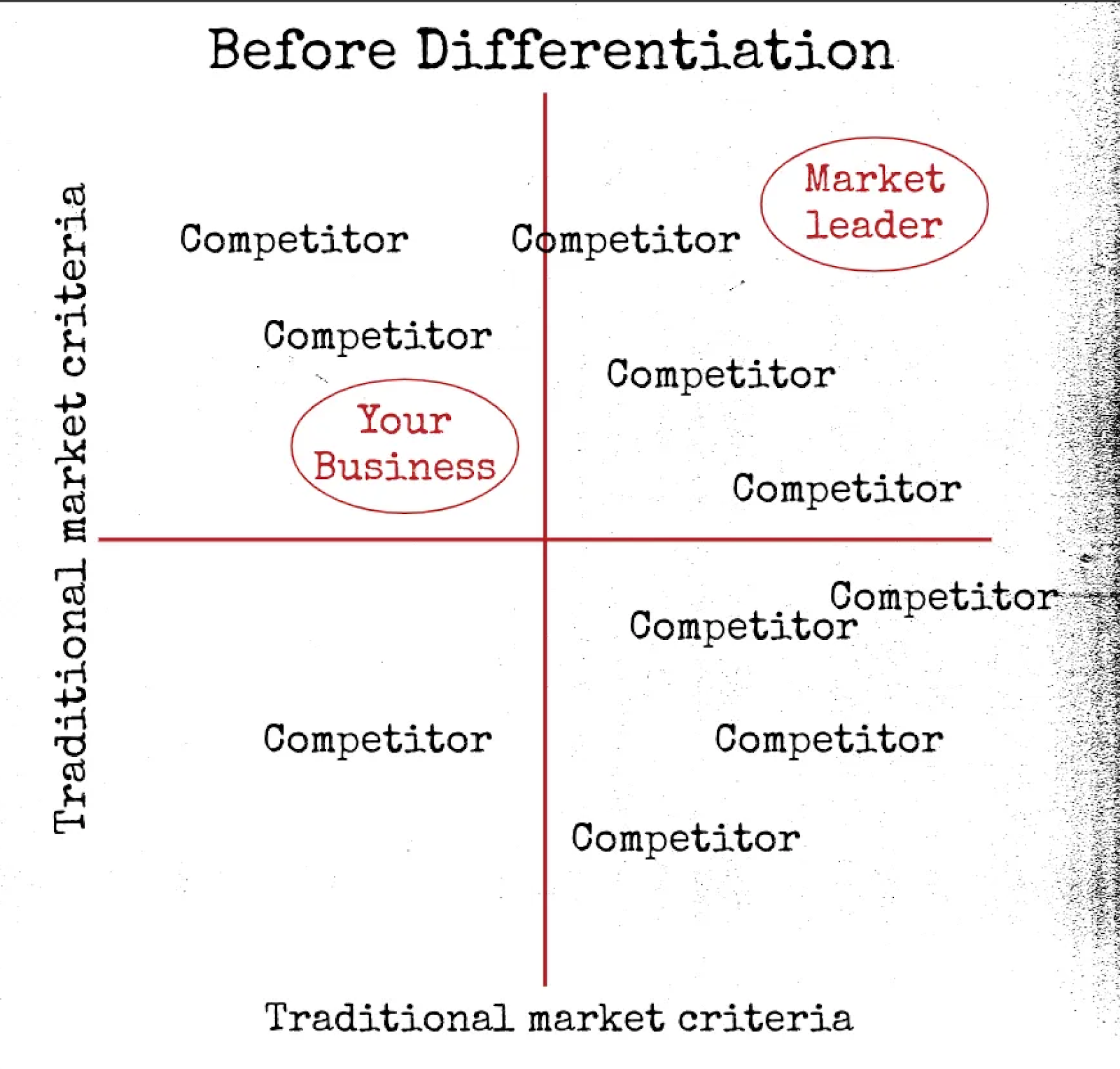
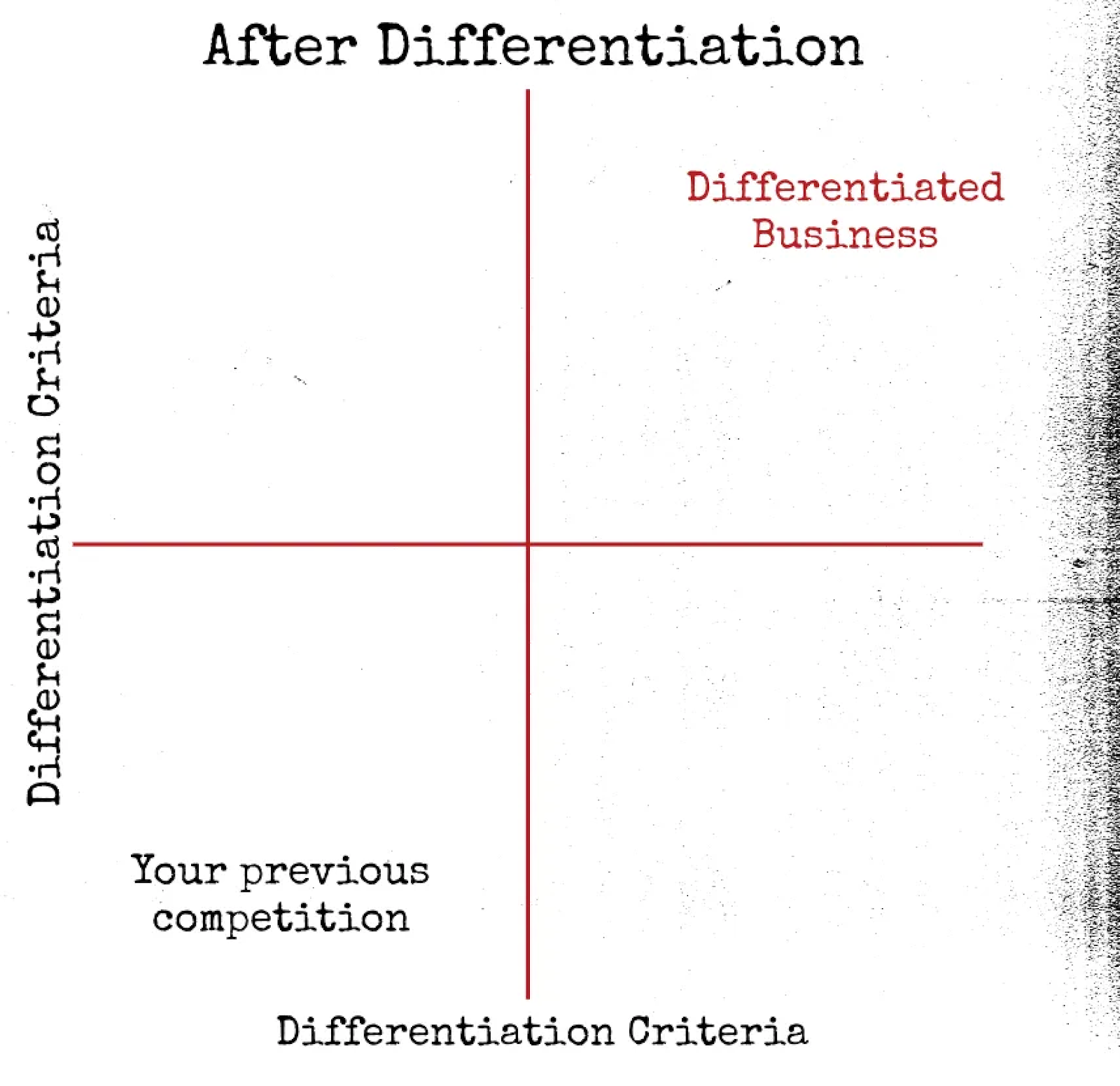
The desired outcome of this phase is a clear, honest answer to: What is our show uniquely positioned to deliver, for whom, and why can't anyone else replicate it?
When you have that answer, you're ready for phase two.
Phase 2: Creatively
Now that you know your differentiated playing field, you get to design a show that expresses it in every possible way. This isn't about slapping your logo on a generic interview format and calling it a day. It's about making creative decisions that are directly informed by your strategy.
Here are some things we always keep in mind with our clients:
Build a show concept that only you could make
- Your format, hosting style, and editorial approach should all flow from what makes your brand unique.
- If your differentiation is deep technical expertise, maybe that means a tightly produced, research-heavy show with no fluff. If it's your community and culture, maybe it's a more conversational, people-first format. Let the strategy lead the creative.
Craft a story worth telling
- Your podcast isn't a press release. It's not a product demo. It's a story that should help your listener see their own world a little differently and keep them coming back because you're giving them something real and unique.
- The best branded podcasts make listeners feel like the brand gets them, their challenges, their questions, and their ambitions. That only happens when the show is built around the audience's actual needs, not the brand’s desire to talk about itself.
- Ask yourself honestly: Would I listen to this show if I didn’t work here? If the answer is no, go back to the drawing board.
Make every element deliberate
- Cover art, episode length, release cadence, music, tone — none of these are afterthoughts. Every touchpoint either reinforces your differentiation or dilutes it.
- Consistency matters enormously here. A differentiated show that drifts in its second season loses the thing that made it worth listening to in the first place.
When strategy and creativity are aligned, every decision is more intentional: what to cover, who to feature, how to evolve the show. Your team has a filter. Your audience knows what to expect. And the show delivers on its promise.
What differentiates your branded podcast?
Differentiation takes courage. You're making a deliberate choice to not blend in, not copy what's already working for someone else, and not play it safe with a format that feels familiar. That can feel uncomfortable, especially when the safe option is right there.
But consider the upside:
- You get to double down on the things your brand already does better than anyone
- You get to define success on your own terms
- You get to build something that no competitor can easily replicate because it's built from your brand, for your audience
That's a much better place to compete from. And it makes for a much better podcast.
If you want to keep exploring ideas like this, subscribe to The Branded Podcaster, our bi-weekly newsletter for marketers and strategists who are serious about building shows that earn attention and deliver results.
Share
About the author

Tianna Marinucci is a content creation and digital marketing specialist. She graduated from McGill University in 2021 and has since worked in a variety of industries from interior design to technology.
After traveling to more than 60 countries and working in three, she is inspired by diverse cultures and motivated by unique experiences.
In her spare time, Tianna loves trying new foods, going to concerts, and learning more about history and socio-economics through books and podcasts.



.png)


.png)
.png)
.png)
.png)